


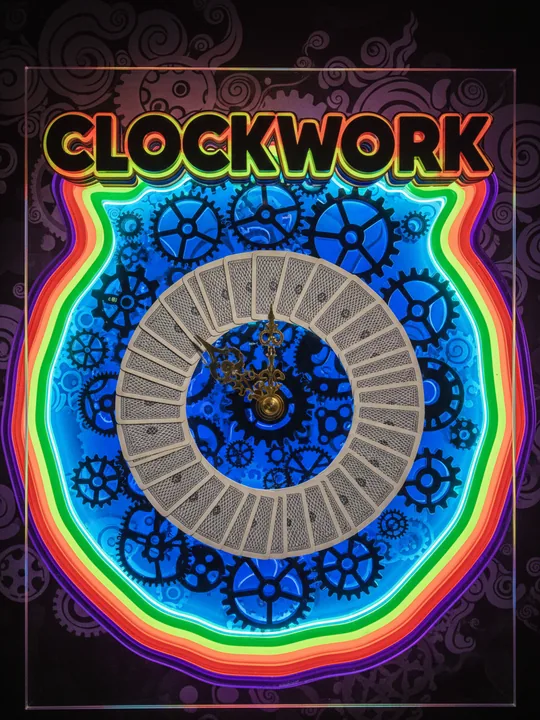
What Clockwork is
Clock patience needs no decisions, which is exactly why it suits a layer you can simply watch. The full deck is dealt into thirteen piles of four: twelve around a clock face for the ace to the queen, and the kings' pile in the middle.
The first card is turned from the middle pile and placed at its own hour, and the next card is turned from that hour's pile, and so on around the clock. A king sends play back to the middle. When the fourth king appears, the round is over.
What counts is how many cards were turned before that last king. Turn all fifty-two and the clock has struck, the best result. That happens about one round in thirteen, which is a classic bit of card arithmetic: the last card turned is a king exactly when the bottom card of the middle pile is, one chance in thirteen.
Playing a round
- Pick a stake of 5, 15, 25, 75 or 150 px.
- Press Deal the clock. The cards are dealt and turned one by one.
- Play stops when the fourth king turns up; the count of cards turned is matched to the paytable.
Paytable
What each result returns. Multiply by your stake, or by the line or column stake where the table says so. The table is printed from the file the game reads.
| Cards turned | Back |
|---|---|
| Under 30 cards | – |
| 30–39 cards | 0.3 × |
| 40–47 cards | 0.8 × |
| 48–51 cards | 1.3 × |
| 52 cards and up | 3.3 × |
Fair play
Every shape, picture, card, die and token is drawn by your browser's cryptographic random source at the moment you press the button. Nothing adapts to you, to your pixels or to how long you have played, and no round remembers another. The paytable on this page is printed from the same data file the game reads. Pixels carry no cash value, cannot be bought, and there is nothing on the site to spend them on.
Questions about Clockwork
Can I change the outcome?
No. Clock patience is decided by the deal; there is nothing to choose. That is why we show every card as it turns.
Why exactly one in thirteen?
The game reaches all fifty-two cards only if the very last card turned is a king, and that last card is always the bottom card of the kings' pile, which is a king one time in thirteen.